

Egg Hoppers
Categories
Categories
- Afghan Cuisine(1)
- American Cuisine(141)
- Australian Cuisine(6)
- Austrian Cuisine(2)
- Belgian Cuisine(1)
- Brazilian Cuisine(3)
- British Cuisine(35)
- Cakes in Sri Lanka(47)
- Canadian Cuisine(1)
- Chinese Cuisine(85)
- Cocktails in Sri Lanka(18)
- Cuban Cuisine(17)
- Dutch Cuisine(1)
- Egyptian Cuisine(3)
- Filipino Cuisine(3)
- French Cuisine(23)
- German Cuisine(9)
- Greek Cuisine(16)
- Hong Kong Cuisine(1)
- Indian Cuisine(79)
- Indonesian Cuisine(15)
- Innovative Sri Lankan Flavours(5)
- Iranian Cuisine(5)
- Irish Cuisine(2)
- Italian Cuisine(112)
- Japanese Cuisine(13)
- Kazakastani Cuisine(1)
- Korean Cuisine(0)
- Malaysian Cuisine(12)
- Mexican Cuisine(13)
- Modern Culinary Trends(40)
- Moroccan Cuisine(2)
- Omani Cuisine(1)
- Russian Cuisine(2)
- Saudi Arabian Cuisine(1)
- Senegalese Cuisine(1)
- Singapore Cuisine(1)
- Spanish Cuisine(7)
- Sri Lankan Authentic Beverages(37)
- Sri Lankan Authentic Curries(66)
- Sri Lankan Authentic Desserts(6)
- Sri Lankan Authentic Food(78)
- Sri Lankan Authentic Seafood(18)
- Sri Lankan Authentic Snacks(20)
- Sri Lankan Authentic Sweets(20)
- Swiss Cuisine(3)
- Taiwanese Cuisine(9)
- Thai Cuisine(21)
- Turkish Cuisine(11)
- Yemeni Cuisine(2)
Egg Hoppers- A Sri Lankan Breakfast Favourite with a Perfectly Cooked Egg
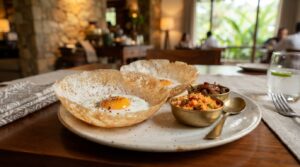
Egg hoppers are a popular Sri Lankan dish that combines the delicate, bowl-shaped texture of a hopper with a freshly cooked egg in the centre. With crispy edges, a soft middle and a warm, satisfying filling, egg hoppers are enjoyed for breakfast, dinner and even as a quick meal at any time of the day.
Known locally as biththara appa, egg hoppers bring together two simple ingredients in a way that highlights the beauty of Sri Lankan cooking. The hopper itself is made from a fermented batter, traditionally prepared with rice flour and coconut milk. When the batter is poured into a hot, rounded pan, it spreads along the sides and cooks into thin, crisp edges while remaining thicker and softer at the bottom.
Adding an egg to the centre makes the dish more filling and gives it a delicious contrast of textures. Whether served with spicy sambol, curry or a simple seasoning of salt and pepper, egg hoppers remain a comforting choice for anyone who enjoys Sri Lankan food.
What Are Egg Hoppers?
Egg hoppers are a variation of traditional Sri Lankan hoppers, also known as appa. Unlike plain hoppers, which are usually served without a filling, egg hoppers contain an egg cooked directly inside the batter.
The dish is prepared in a special hopper pan with a rounded base. The batter forms a thin layer around the sides of the pan, creating the characteristic bowl shape. An egg is then cracked into the centre and allowed to cook as the batter sets.
A well-made egg hopper has lightly browned, crispy edges and a soft centre surrounding the egg. Depending on personal preference and cooking time, the yolk can remain slightly runny or become more firmly cooked.
Egg hoppers are commonly found at Sri Lankan breakfast stalls, local restaurants, small eateries and roadside food shops. Their simple preparation and satisfying flavour have helped them maintain a place in everyday Sri Lankan food culture.
The Traditional Hopper Batter
The foundation of a good egg hopper is its batter. Traditional hopper batter is generally made using rice flour or soaked and ground rice, coconut milk, water and a fermenting ingredient such as yeast or a naturally fermented mixture. Some recipes include a small amount of sugar to support fermentation and balance the flavour.
Fermentation gives the batter its characteristic aroma and helps create a light texture. The batter needs the right consistency to coat the curved sides of the pan without becoming too thick or too watery.
Coconut milk contributes a gentle richness that complements the egg. As the batter cooks, the thin layer around the edges becomes crisp while the thicker centre remains softer.
Although recipes differ between households and cooks, the aim is to create a batter that spreads evenly and cooks into the familiar hopper shape. Properly heating and preparing the pan is equally important because it helps prevent sticking and allows the edges to brown.
How Egg Hoppers Are Prepared
Making egg hoppers requires a little technique, particularly when shaping the batter and cooking the egg evenly.
First, the prepared batter is poured into a heated hopper pan. The cook rotates the pan so that the batter coats the curved sides, leaving a thicker layer at the bottom. The batter begins to set as it comes into contact with the hot surface.
Next, an egg is cracked carefully into the centre. A small amount of salt and pepper may be added, depending on the cook’s preference. The pan is then covered to help the egg cook with the surrounding batter.
As the hopper cooks, the edges become crisp and lightly golden. The egg white gradually sets, while the yolk cooks according to the desired doneness and cooking time. Once ready, the hopper is gently removed from the pan and served hot.
The best egg hoppers balance the textures of the crispy outer edge, soft inner batter and cooked egg. Achieving that balance depends on the batter consistency, pan temperature and cooking technique.
What Makes Egg Hoppers Special?
One of the most appealing features of egg hoppers is their contrast in texture. The thin, crispy edges provide a delicate crunch, while the centre remains soft enough to complement the egg.
The flavour is another important part of the experience. The mild taste of the rice-based batter and coconut milk pairs naturally with the richness of the egg. Rather than relying on complicated ingredients, the dish makes the most of a few familiar staples.
Egg hoppers are also versatile. They can be enjoyed as a simple meal with a little seasoning or paired with a range of Sri Lankan accompaniments. Their individual serving size makes them convenient to prepare and serve fresh, particularly in busy restaurants and breakfast shops.
For many people, egg hoppers also bring a sense of familiarity. They are often associated with early-morning food stalls, family meals and evenings when a fresh batch of hoppers is served straight from the pan.
Popular Accompaniments for Egg Hoppers
Egg hoppers are delicious on their own, but the right accompaniment can make the meal even more enjoyable.
Pol sambol: Made with grated coconut, chilli, onion, lime and seasonings, pol sambol adds a spicy, tangy flavour that contrasts with the mild hopper batter.
Lunu miris: This traditional onion and chilli sambol offers a stronger, sharper flavour. It is a good option for people who enjoy a little heat with their food.
Seeni sambol: Sweet, savoury and gently spiced, seeni sambol provides a different flavour profile. Its sweetness pairs well with the egg and coconut-rich batter.
Sri Lankan curries: Some people enjoy hoppers with dhal curry or other Sri Lankan curries. The curry can be eaten alongside the hopper or spooned onto it for a more substantial meal.
Plain seasoning: A little salt and pepper may be enough for those who prefer to appreciate the flavour of the egg and batter without additional accompaniments.
The best pairing depends on individual taste, and trying different combinations is part of the enjoyment of Sri Lankan hopper dishes.
Egg Hoppers for Breakfast and Dinner
Egg hoppers are suitable for more than one mealtime. For breakfast, they offer a warm and satisfying option that can be served with sambol or curry. Their combination of batter and egg makes them more substantial than a plain hopper.
They are also popular as an evening meal. Many Sri Lankan eateries prepare hoppers to order, allowing customers to enjoy them while they are still hot and crisp. A serving of egg hoppers with spicy sambol can be a simple yet flavourful dinner.
For restaurants, egg hoppers can be part of a traditional Sri Lankan breakfast menu or included in a wider selection of local dishes. They also provide an approachable introduction to hoppers for visitors who want to explore Sri Lankan food beyond rice and curry.
Because they are best enjoyed fresh, the timing of preparation matters. Serving them directly from the pan helps preserve their crisp edges and soft centre.
Egg Hoppers and Sri Lankan Food Culture
Sri Lankan cuisine is known for making everyday ingredients memorable through preparation, seasoning and the use of coconut, rice and spices. Hoppers are a clear example of this tradition.
Plain hoppers, egg hoppers and other variations offer different ways to enjoy a familiar batter. Each version has its own appeal, from the simplicity of a plain hopper to the richer centre of an egg hopper.
The dish is also part of Sri Lanka’s wider food landscape, appearing in homes, small neighbourhood eateries and restaurants that specialise in local cuisine. Although individual recipes and serving styles vary, the distinctive bowl-shaped hopper remains instantly recognisable.
For travellers, trying egg hoppers can be a delicious way to experience an everyday part of Sri Lankan food culture. For local diners, they remain a familiar favourite that can be enjoyed with different accompaniments and at different times of the day.
Final Thoughts
Egg hoppers show how a few simple ingredients can come together to create one of Sri Lanka’s most enjoyable traditional dishes. With their crispy edges, soft centre and freshly cooked egg, they offer a satisfying combination of texture and flavour.
Whether you enjoy them with pol sambol, lunu miris or a favourite Sri Lankan curry, egg hoppers are a wonderful choice for breakfast or dinner. The next time you visit a local hopper shop, try them fresh from the pan and discover what makes this classic dish so special.
Looking for delicious Sri Lankan food and more culinary discoveries? Explore Lankaura, Sri Lanka’s food discovery platform…!

