

Kurakkan String Hoppers
Categories
Categories
- Afghan Cuisine(1)
- American Cuisine(141)
- Australian Cuisine(6)
- Austrian Cuisine(2)
- Belgian Cuisine(1)
- Brazilian Cuisine(3)
- British Cuisine(35)
- Cakes in Sri Lanka(47)
- Canadian Cuisine(1)
- Chinese Cuisine(85)
- Cocktails in Sri Lanka(18)
- Cuban Cuisine(17)
- Dutch Cuisine(1)
- Egyptian Cuisine(3)
- Filipino Cuisine(3)
- French Cuisine(23)
- German Cuisine(9)
- Greek Cuisine(16)
- Hong Kong Cuisine(1)
- Indian Cuisine(79)
- Indonesian Cuisine(15)
- Innovative Sri Lankan Flavours(5)
- Iranian Cuisine(5)
- Irish Cuisine(2)
- Italian Cuisine(112)
- Japanese Cuisine(13)
- Kazakastani Cuisine(1)
- Korean Cuisine(0)
- Malaysian Cuisine(12)
- Mexican Cuisine(13)
- Modern Culinary Trends(40)
- Moroccan Cuisine(2)
- Omani Cuisine(1)
- Russian Cuisine(2)
- Saudi Arabian Cuisine(1)
- Senegalese Cuisine(1)
- Singapore Cuisine(1)
- Spanish Cuisine(7)
- Sri Lankan Authentic Beverages(37)
- Sri Lankan Authentic Curries(66)
- Sri Lankan Authentic Desserts(6)
- Sri Lankan Authentic Food(78)
- Sri Lankan Authentic Seafood(18)
- Sri Lankan Authentic Snacks(20)
- Sri Lankan Authentic Sweets(20)
- Swiss Cuisine(3)
- Taiwanese Cuisine(9)
- Thai Cuisine(21)
- Turkish Cuisine(11)
- Yemeni Cuisine(2)
Kurakkan String Hoppers – A Traditional Sri Lankan Favourite
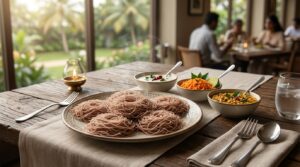
Sri Lankan cuisine is known for its variety of traditional foods made from rice, grains, and locally available ingredients. Among these favourites, idiappa, commonly known as string hoppers, holds a special place in many households. Kurakkan idiappa offers a variation of this familiar dish by incorporating finger millet flour, giving the string hoppers a distinctive colour and earthy flavour.
Often served with coconut sambol, dhal curry, or kiri hodi, kurakkan string hoppers brings together a traditional preparation and the characteristic taste of kurakkan. It is an interesting dish for anyone looking to explore the different varieties of Sri Lankan food.
What Is Kurakkan String Hoppers?
Kurakkan idiappa is a variation of Sri Lankan string hoppers prepared using finger millet flour, either on its own in a suitable recipe or combined with rice flour or other ingredients.
Traditional string hoppers are made by preparing a smooth dough, pressing it through a special string hopper mould, and steaming the thin strands into delicate circular nests. When kurakkan flour is used, the finished string hoppers generally have a darker brown colour and a distinctive grain flavour.
Recipes vary between households. Some combine kurakkan flour with rice flour to help achieve the desired texture, while others use different proportions according to the consistency of the flour and the preferred result.
What Is Kurakkan?
Kurakkan is the Sinhala name for finger millet, a grain cultivated in Sri Lanka and several other countries. It is traditionally ground into flour and used in a variety of foods, including roti, pittu, porridge, and other home-cooked preparations.
Finger millet has a naturally earthy, slightly nutty flavour that distinguishes it from rice flour. Its colour also gives dishes prepared with kurakkan a characteristic appearance.
The grain contains carbohydrates, dietary fibre, and minerals, including calcium. Its nutritional composition varies with processing and preparation, making it an interesting ingredient in traditional grain-based cooking.
How Is Kurakkan String Hoppers Prepared?
Preparing kurakkan idiappa involves several steps, and the exact method depends on the recipe.
First, the kurakkan flour is combined with the appropriate ingredients to create a dough. Some recipes use rice flour to help improve the dough’s consistency. Hot water is often added gradually, along with salt, until the mixture becomes suitable for pressing.
The dough is placed into a string hopper press fitted with a fine-holed mould. It is then pressed into thin strands arranged in circular patterns on small string hopper mats or trays.
The shaped string hoppers are steamed until cooked. The steaming process helps the strands set while retaining their delicate texture.
When prepared correctly, kurakkan idiappa should hold its shape while remaining tender enough to separate easily when served.
What Does Kurakkan String Hoppers Taste Like?
Kurakkan string hoppers has a more pronounced grain flavour than conventional rice-flour string hoppers. Finger millet contributes a gentle earthiness and nuttiness, while the texture depends on the flour combination and preparation method.
The string hoppers themselves are relatively mild, allowing them to complement a variety of curries and sambols. Their soft, delicate strands absorb sauces and gravies, making them particularly suitable for meals with coconut-based accompaniments.
The balance of kurakkan and rice flour can influence the final texture. A well-prepared batch should be tender and hold together without becoming excessively hard or crumbly.
Popular Accompaniments for Kurakkan String Hoppers
Kurakkan string hoppers can be served with many of the accompaniments traditionally enjoyed with Sri Lankan string hoppers.
- Kiri Hodi – This mild coconut milk gravy is a familiar partner for string hoppers. Its creamy texture complements the earthy flavour of finger millet.
- Pol Sambol – Made with grated coconut, chilli, onion, lime, and seasonings, pol sambol provides a spicy and tangy contrast.
- Dhal Curry – Creamy dhal curry adds warmth and savoury flavour, creating a satisfying combination with the soft string hoppers.
- Chicken or Fish Curry – For those who prefer a more substantial meal, a suitable curry can be served alongside kurakkan idiappa.
- Lunu Miris – This spicy onion and chilli sambol offers a bold accompaniment for people who enjoy stronger flavours.
The combination can be adjusted according to personal taste, making kurakkan idiappa suitable for a variety of meals.
Kurakkan String Hppers in Sri Lankan Food Culture
String hoppers are widely enjoyed across Sri Lanka, particularly for breakfast and dinner. They are commonly prepared at home and served with a selection of curries and sambols.
Kurakkan string hoppers brings a traditional grain into this familiar preparation. It demonstrates how Sri Lankan cooking can adapt everyday dishes by using different flour varieties and ingredient combinations.
The result is a recognisable local favourite with a different colour and flavour, allowing people to explore a variation of string hoppers without moving away from familiar serving traditions.
Final Thoughts
Kurakkan string hoppers combines the delicate texture of string hoppers with the earthy flavour of finger millet. Served with kiri hodi, pol sambol, dhal curry, or a favourite Sri Lankan curry, it offers an interesting variation on a familiar meal.
For anyone curious about traditional grains and the diversity of Sri Lankan cuisine, kurakkan idiappa is a delicious food discovery worth exploring.
Looking for more delicious culinary discoveries? Explore more Lankaura.
